Home humidity guide · Personal experience
Why Mould Appears After a Holiday in Singapore—and How a Dehumidifier Helps
After returning from a holiday in Korea, HomeFlex’s operator found a serious mould problem at home. Painting and related restoration eventually cost about S$6,000. That experience taught a late but useful lesson: think about moisture before leaving a home closed for an extended period.
Last updated: 2026-09-02
1. Why mould can appear after a holiday
Mould needs moisture. A closed home may have less air movement while everyday sources such as damp bathrooms, wet materials, small leaks or condensation continue to add moisture. The longer the source remains, the more opportunity mould has to grow on suitable surfaces.
2. Singapore humidity and a closed home
Singapore’s Meteorological Service describes high humidity throughout the year, with mean annual relative humidity around 82%. Outdoor humidity is not the same as indoor humidity, but it explains why simply opening windows is not always a reliable drying strategy in warm, humid weather.
3. What a dehumidifier can—and cannot—do
The US EPA advises keeping indoor relative humidity below 60% where possible, ideally 30–50%. In Singapore, treat that as a reference range and use a hygrometer and the home’s real conditions rather than forcing an impractical setting.
- It can remove moisture from room air and help manage an environment in which mould grows more readily.
- It cannot automatically remove mould that is already present.
- It cannot repair a leak, waterproofing defect or recurring condensation source.
- It does not guarantee health improvement or replace professional assessment.
4. Humidity checklist before travel
- Check for leak or condensation marks.
- Set up a hygrometer.
- Leave safe airflow around wardrobes and furniture.
- Dry wet bathroom and kitchen areas.
- Confirm whether continuous drainage is possible.
- If operating any appliance while the home is unattended, follow the manufacturer’s safety instructions.
- After returning, inspect walls, ceilings, wardrobes and behind furniture.
5. What to do first when mould is already present
Identify and address the water or moisture source before repainting. Cleanup method depends on the affected material and extent. The EPA advises considering experienced professional help for larger areas, significant water damage, repeated growth, suspected hidden mould or contaminated water.
Do not paint over visible mould. Cleanup and complete drying come before cosmetic repair. Seek appropriate professional or healthcare advice if the situation or personal health concerns warrant it.
6. Laundry drying and musty odours
A dehumidifier can support indoor laundry drying by reducing moisture in the surrounding air. Keep doors and windows arranged according to the product instructions, maintain airflow around clothes and empty or drain the tank safely. A musty smell is a prompt to inspect for damp materials or hidden moisture, not something to mask.
7. Capacity and placement considerations
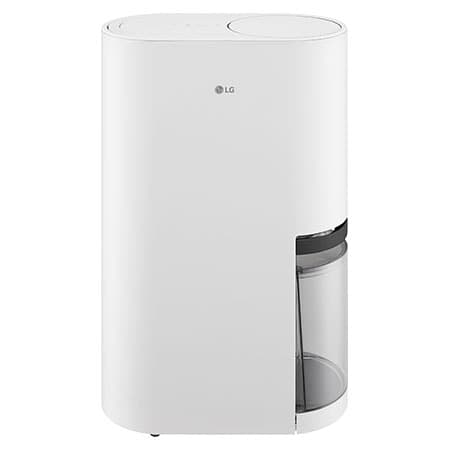
HomeFlex currently lists the LG DD20GMWE1 Dual Inverter Dehumidifier. Existing product data records Smart+ Mode, Dual Inverter Compressor, Laundry Mode and a UVnano-applied fan, with current LG Careship fees of 3 years S$49/month, 5 years S$35/month and 7 years S$25/month. Confirm current availability, pricing, exact capacity and instructions before applying.
- Match rated extraction capacity to room size and moisture load.
- Check operating temperature, tank size and continuous-drain requirements.
- Allow the clearances stated by the manufacturer.
- Place the unit where air can circulate; do not obstruct intake or outlet.
- For multiple closed rooms, one unit in a hallway may not control every space equally.
Public guidance used
FAQ
Frequently asked questions
Will a dehumidifier remove existing mould?
No. It helps manage airborne moisture. Existing mould must be cleaned appropriately and the moisture source must be fixed.
What indoor humidity should I aim for?
The US EPA recommends below 60% if possible, ideally 30–50%. Treat this as guidance and account for Singapore’s climate, the room and the appliance instructions.
Can I leave a dehumidifier running while away?
Only if the manufacturer’s instructions permit the intended unattended operation and the power, drainage, placement and maintenance conditions are safe. Check the exact model manual.
When should I consider professional help?
Consider it for extensive or recurring mould, significant water damage, suspected hidden growth, contaminated water or when you are unsure how to clean safely.